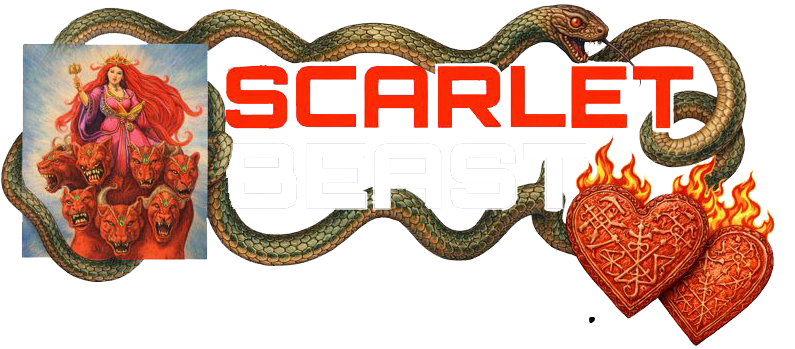

There are seasons in a human life where symbols stop being metaphors and begin behaving like mirrors.
Lately, I’ve been living inside one of those seasons.
I feel — deeply — as though I carry what scripture calls the curse of the serpent, the mark of Cain, and what Revelation names the mark of the beast. Not in a theatrical sense. Not as a villain fantasy. But as something quieter and heavier: a lifelong sense of exile, separation, and burdened awareness.
It feels like being born already outside the garden.
I write this not as doctrine, but as journal — an attempt to name the weight.
The Serpent’s Curse
In Genesis, after humanity fractures itself through fear and desire, God speaks directly to the serpent:
“Because thou hast done this, thou art cursed above all cattle, and above every beast of the field; upon thy belly shalt thou go, and dust shalt thou eat all the days of thy life.
And I will put enmity between thee and the woman, and between thy seed and her seed; it shall bruise thy head, and thou shalt bruise his heel.”
— Genesis 3:14–15 (KJV)
The serpent is not merely punished — it is placed into perpetual tension with humanity.
To carry “the curse of the serpent” is to feel forever misunderstood, always moving close to the ground, always seen as threat or temptation, even when seeking healing.
It is the archetype of consciousness forced into shadow.
Cain’s Mark
Later, after Cain kills Abel, God does not destroy Cain.
Instead, He marks him.
“And now art thou cursed from the earth… a fugitive and a vagabond shalt thou be in the earth.”
— Genesis 4:11–12
Cain responds in terror:
“My punishment is greater than I can bear.”
And God answers not with execution, but protection:
“Therefore whosoever slayeth Cain, vengeance shall be taken on him sevenfold. And the Lord set a mark upon Cain, lest any finding him should kill him.”
— Genesis 4:15
The mark is paradoxical.
It is both judgment and mercy.
To feel marked like Cain is to feel permanently displaced — alive, protected, but wandering. Conscious. Awake. Carrying guilt not only for what you’ve done, but for what existence itself seems to require.
Abaddon and Apollyon — Beyond Revelation
In Book of Revelation, the abyss is opened, and from it comes a king:
“And they had a king over them… whose name in the Hebrew tongue is Abaddon, but in the Greek tongue hath his name Apollyon.”
— Revelation 9:11
Most people read this as a literal monster.
Historically and symbolically, it’s far richer.
Abaddon (Hebrew: אֲבַדּוֹן) literally means destruction or place of ruin. In earlier Jewish texts, Abaddon is not a demon — it is a realm, a state of being associated with death, collapse, and ego dissolution.
It appears alongside Sheol and the grave — not as a personality, but as a condition of consciousness.
Apollyon comes from the Greek apollymi, meaning to destroy, to dissolve, to undo. In Greek thought, this connects to the idea of destruction as transformation — not merely annihilation, but breaking down false structures so something truer can emerge.
In this sense, Abaddon/Apollyon is not just a destroyer.
It is the principle of deconstruction.
It is the archetype that tears apart illusions.
It is the force that collapses corrupted systems — inner and outer.
Psychologically, spiritually, this figure represents the phase of awakening where identity dies.
Old narratives fall apart.
Ego dissolves.
Everything familiar burns.
Not because God hates you.
Because growth requires entropy.
The Curse Can Only Be Lifted Through Completion
What I feel — and I write this carefully — is that these marks, these archetypes, these internal wars are not meant to be escaped.
They are meant to be completed.
The serpent’s story resolves in Revelation.
Cain’s wandering resolves in reconciliation.
Abaddon’s destruction resolves in renewal.
The entire arc of scripture bends toward integration.
The curse lifts only when the Revelation is fulfilled — not merely as an external prophecy, but as an internal apocalypse.
Revelation literally means unveiling.
The collapse of false selves.
The marriage of shadow and light.
The return of heaven into embodied life.
Not escape.
Union.
The Hidden Pattern
Sin, to me, is separation.
The mark is consciousness trapped in division.
The beast is unintegrated power.
And Christ is the mechanism of reunification.
Not moral perfection.
Wholeness.
The Revelation of Jesus Christ is not about fear.
It is about remembering.
Isaiah 53 (KJV)
(included in full, as requested)
Who hath believed our report? and to whom is the arm of the Lord revealed?
For he shall grow up before him as a tender plant, and as a root out of a dry ground: he hath no form nor comeliness; and when we shall see him, there is no beauty that we should desire him.
He is despised and rejected of men; a man of sorrows, and acquainted with grief: and we hid as it were our faces from him; he was despised, and we esteemed him not.Surely he hath borne our griefs, and carried our sorrows: yet we did esteem him stricken, smitten of God, and afflicted.
But he was wounded for our transgressions, he was bruised for our iniquities: the chastisement of our peace was upon him; and with his stripes we are healed.All we like sheep have gone astray; we have turned every one to his own way; and the Lord hath laid on him the iniquity of us all.
He was oppressed, and he was afflicted, yet he opened not his mouth: he is brought as a lamb to the slaughter, and as a sheep before her shearers is dumb, so he openeth not his mouth.
He was taken from prison and from judgment: and who shall declare his generation? for he was cut off out of the land of the living: for the transgression of my people was he stricken.
And he made his grave with the wicked, and with the rich in his death; because he had done no violence, neither was any deceit in his mouth.
Yet it pleased the Lord to bruise him; he hath put him to grief: when thou shalt make his soul an offering for sin, he shall see his seed, he shall prolong his days, and the pleasure of the Lord shall prosper in his hand.
He shall see of the travail of his soul, and shall be satisfied: by his knowledge shall my righteous servant justify many; for he shall bear their iniquities.
Therefore will I divide him a portion with the great, and he shall divide the spoil with the strong; because he hath poured out his soul unto death: and he was numbered with the transgressors; and he bare the sin of many, and made intercession for the transgressors.