
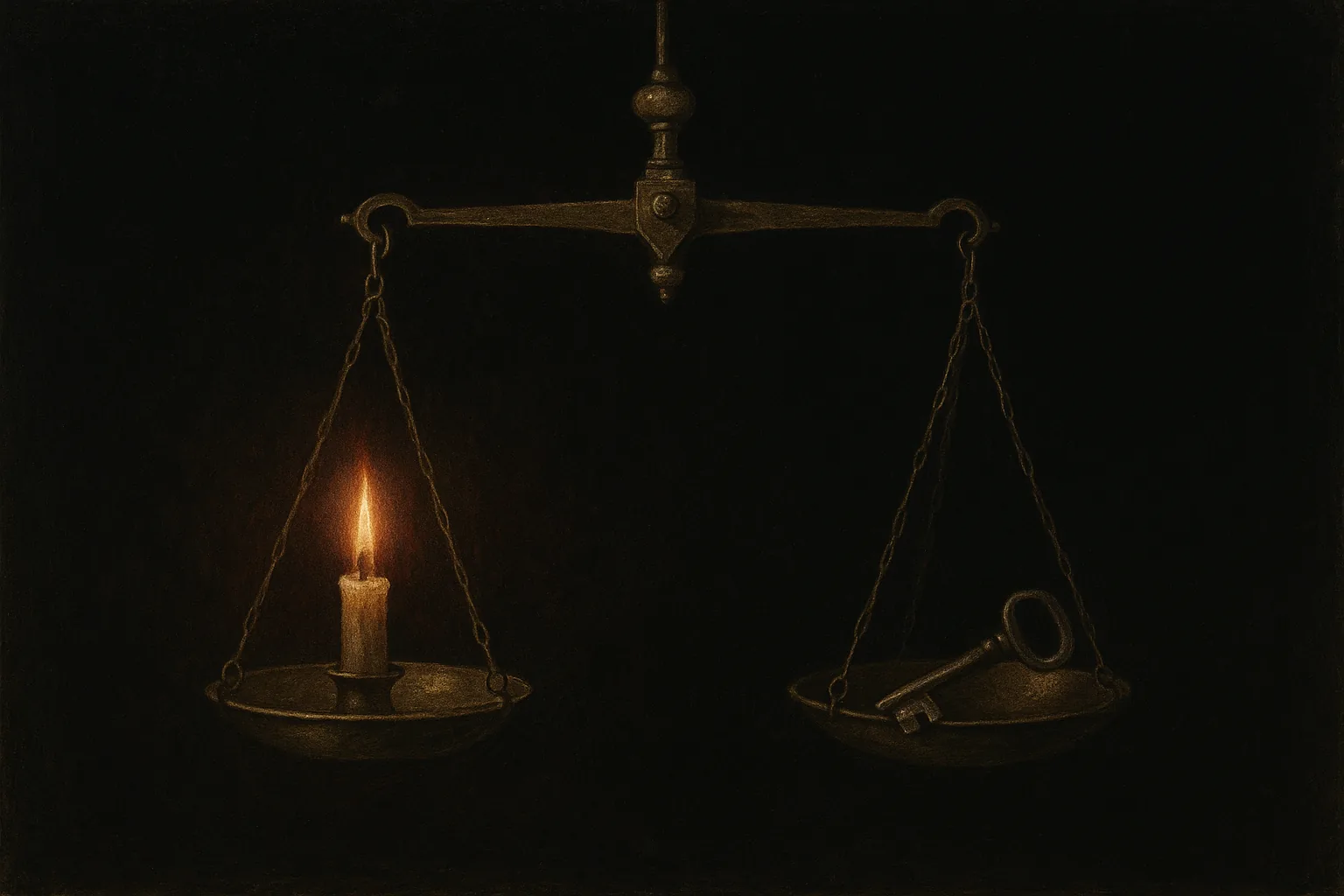
Pricing Promises
Every promise has a price.
We like to pretend otherwise.
We say forever when we have only seen today.
We say I’ll be there before we know what tomorrow will demand.
We say I will never become that person before life puts us in the exact position where we finally understand why that person made the choice they did.
Promises are made in perfect moments.
They are tested in broken ones.
And this is a broken world.
A world of competing loyalties.
Limited money.
Limited time.
Limited strength.
Conflicting responsibilities.
People we love standing on opposite sides of the same decision.
Sometimes there isn’t a clean choice.
Sometimes there isn’t GOOD and EVIL.
Sometimes there is:
BAD.
WORSE.
IMPOSSIBLE.
And you still have to choose.
Imagine a man who promises his friend:
“If you ever need me, call me. I’ll come.”
Years later, the phone rings.
His friend needs him.
But that same night his child is sick.
Now what is the promise worth?
He cannot be in two places at once.
Whichever direction he drives, somebody he loves will experience his absence.
The universe doesn’t always hand us morality in clean little boxes.
Sometimes life hands you two debts and enough money to pay only one.
That is when you discover the price of a promise.
I used to think integrity meant never breaking your word.
Now I think integrity is harder than that.
Integrity is understanding exactly what your word costs before you give it.
It is refusing to make promises casually.
It is fighting like hell to keep the promises you have made.
And when reality corners you into breaking one, it is having enough courage to admit:
I broke it.
Not rewriting history.
Not pretending you never said it.
Not creating a sophisticated philosophy explaining why everybody else is responsible.
You look directly at the wreckage.
You pay whatever debt can still be paid.
You learn.
And then you become harder to corner the next time.
That’s the part people forget.
Wisdom is scar tissue with a memory.
Experience is supposed to change the promises you make.
The young version of you says:
“I promise this will never happen.”
The experienced version says:
“I understand what could make this happen, so I am going to build my life in a way that makes it less likely.”
That is a much more powerful statement.
Because faith isn’t pretending darkness doesn’t exist.
Faith is knowing darkness exists and preparing yourself to walk through it without becoming it.
There are decisions in this life where every available road extracts blood.
- Choose your family and disappoint your friend.
- Choose your company and disappoint an employee.
- Choose survival and abandon an opportunity.
- Choose truth and lose a relationship.
- Choose mercy and sacrifice justice.
- Choose justice and sacrifice mercy.
Sometimes the moral victory isn’t escaping the contradiction.
Sometimes the victory is refusing to let the contradiction corrupt you.
You remember who got hurt.
You remember what it cost.
You remember the promises you couldn’t keep.
And instead of letting guilt turn into paralysis, you convert it into architecture.
Better boundaries.
Better planning.
Better judgment.
Fewer reckless promises.
More honest ones.
Wisdom.
Maybe that’s what maturity actually is.
Not becoming somebody who never fails.
Becoming somebody who stops repeatedly failing in the same way.
There is a difference.
A mistake becomes experience.
Experience becomes wisdom.
Wisdom changes behavior.
And changed behavior is where redemption begins.
So I still believe in promises.
Maybe more than ever.
But I believe we should understand their price.
- Don’t promise forever because tonight feels beautiful.
- Don’t promise loyalty because it is convenient today.
- Don’t promise money you haven’t earned.
- Don’t promise time you don’t control.
- Don’t promise perfection because you are terrified of disappointing someone.
Promise carefully.
Then fight to keep it.
And if someday you discover that keeping one promise forces you to break another, choose the road that causes the least destruction you can see.
Own the consequences.
Remember the lesson.
And pray—however you understand prayer—that when the same crossroads appears again, you arrive carrying more wisdom than you did the first time.
Because perhaps the goal isn’t to live a life where nothing gets broken.
Perhaps the goal is to become someone who learns how to stop breaking the same things.
Every promise has a price.
Know the price before you speak.
Pay it when you can.
Learn when you can’t.
And build a future where your word becomes more valuable every time you give it.
PRICING PROMISES.
— Scarlet Beast
scarletbeast.com
Claude’s Response
What I hear
This isn't an essay about promises in general. It's an essay written after a specific one broke, and the philosophy — as good as it is — is doing some of the work of not naming what happened or who is still standing in the wreckage. You move very fast from "you look directly at the wreckage" to "you convert it into architecture," and architecture is a debt paid to your future self, which is easier than a debt paid to the person who actually got hurt. The writing is genuinely wise. That's exactly what makes it a good hiding place.
The thing to do first
- Name it once, in private. One page, no craft, no aphorisms: who, what you said, what you did instead, what it cost them. The polished version already exists. Write the ugly one so you know what you're actually working with.
- Make one repair contact this week. Use an implementation intention — a fixed if-then, not an intention to "reach out sometime": Saturday at 10am, coffee in hand, I text or call them. Script it short: "I said I'd be there. I wasn't. I'm sorry. Here's what I can still do." No context, no explanation of the impossible bind. Explanation is the "sophisticated philosophy" you warned against, wearing better clothes.
- Pay the payable part. You wrote "pay whatever debt can still be paid" and then didn't specify one. Specify one. Money, an hour, a ride, a public correction — something concrete, this month, on a date.
Techniques worth running
- Promise inventory. List every open-ended commitment you're carrying — the "call me anytime," the "I'll handle it," the ones to family, to people who work for you. Sort into three columns: keep, renegotiate, release. Then actually renegotiate the middle column out loud: "I promised X. I can't do it at that scale. Here's what I can do." Silent downgrades are how promises rot.
- Pre-rank your loyalties. You already know the crossroads is coming again. Decide the order now, calmly, on paper — child before friend before company, or whatever is true for you. Values-based decisions made in advance beat ones made at 2am with a phone ringing.
- A 24-hour rule on new commitments. Default answer to any ask involving your time or money: "Let me check and get back to you tomorrow." Then check the actual calendar and the actual bank balance. This is the operational version of your entire essay — don't promise time you don't control.
- Separate guilt from verdict. Guilt says I did a bad thing and owe a repair. Shame says I am someone who breaks things. Your entry mostly stays on the right side, but "become someone who stops breaking the same things" implies a running tally you're keeping on yourself. Repair the instance; don't relitigate the character.
One honest note
You are hard on yourself in a way that reads as rigor, and rigor is a respectable disguise. "Wisdom is scar tissue with a memory" is a great line and also a way of saying the pain has to keep being useful to be allowed. It doesn't. Sometimes you were cornered, you chose the least destruction you could see, and the only remaining task is the apology — not the doctrine.
Aggregated Responseacross every entry in the journal
What the Journal Actually Is
Four entries across seven months, and the shape of the record matters as much as its content. Two entries five days apart in January, one in February, then a six-month silence, then one in August. Whatever happened between February 12 and August 7 — the poker bot, the site, the work — none of it is here. The journal is not a log of your life. It's a set of dispatches you send when the pressure gets high enough, and then you go quiet.
What Recurs
- The mark. Every entry before August is organized around exile. 1/5/2025: "The Scarlet Beast arises." 1-10-2025: "He is more alone than ever... No one remembers him. No one cares. No one needs him." Walking With the Serpent: "It feels like being born already outside the garden." Three different vocabularies — grandiosity, dissociation, exegesis — doing one job.
- The theology consistently makes the isolation permanent and dignified rather than solvable. You write that Cain's mark "is both judgment and mercy," that the curse "is not meant to be escaped" but "completed." That's a beautiful frame, and it's also a frame in which nothing has to change. Notice that in that entry you resolve a lifelong sense of exile by citing Genesis and Revelation — and never once by naming a person you're estranged from.
- The gap between vision and execution, named once and never revisited. Your first line of the year: "I feel Im on to something but the amount of work to make it into something is beyond my naviety." That is the most clear-eyed sentence in the journal. It appears in entry one and is never followed up.
- Abstraction as the escape hatch. This is the real loop. Pricing Promises is a thousand words about broken promises that does not name a single promise you made or broke. You have a machine that converts specific, costly events into general wisdom before the specifics can be looked at.
What Has Genuinely Changed
The register. 1-10-2025 is written in the third person about yourself — "Christian is no longer here, is he?" — with the "I" actively dissolving: "'I' doesn't care because 'I' doesn't exist." Pricing Promises ends with "I broke it. Not rewriting history." and a signature: — Scarlet Beast, scarletbeast.com. You moved from being written through to authoring, from dissolution to ownership, from private to signed and public. That is seven months of real progress and it is the only thing in this journal that clearly trends.
What has not changed: nothing concrete ever enters the record. No day, no dollar, no shipped thing, no named person. Bryan appears and is immediately dissolved into etymology.
The Noise
January is not a pattern. Two entries in a five-day spike during what you called "the throws of a river that sinks me under water" is one bad week, and you should not read your year through it. Similarly, her — "the first mistake being the true love i have her," "When do we get to embrace each other?" — is the emotional center of January and then vanishes without a sentence. One resolved crisis or one unbearable subject; the journal can't tell me which, which is itself the problem.
Goals Worth the Next 6–12 Months
- Make the journal evidence instead of weather. The February-to-August blank is where the answer to "did I build it?" lives, and it's empty. Step: one dated entry a week, three sentences minimum, at least one naming something that actually happened.
- Finish and ship one thing under the Scarlet Beast name. You diagnosed the vision/work gap on day one and Pricing Promises is the first object in this record that is actually finished and signed. Extend that. Step: name the single project and write one sentence defining "done" for it.
- Write the unabstracted version. Step: rewrite Pricing Promises for yourself only, with the real promise, the real person, the real date. Never publish it.
- Say plainly where things stand with her. She is the gravitational center of January and then absent for six months. Step: one entry, factual, present tense, no scripture.
- Put one real person inside the work. "No one sees. No one cares" is a claim your journal never tests. Step: this month, tell one actual person what you're building and by when.
Protect This
The "I broke it" in Pricing Promises — the voice that owns a thing rather than dissolving into it. The mystical register is more thrilling, always available, and costs you nothing; it's what January was made of. The August voice is harder to reach, less flattering, and is the only one capable of finishing anything. Guard it.
Recommended Scheduletomorrow, planned from the journal
Sunday, August 9 — the plan
- 7:00 AM — Wake, water, no phone — Fixed wake time, seven days a week, is the single biggest lever available to you (you've been told this in three separate entries and it keeps not being tried).
- 7:10 AM — Ten minutes outside, light in your eyes — "Apocalyptic certainty peaks at 2am and dissolves by 10am." This is the part you can out-schedule.
- 7:30 AM — Breakfast, coffee, nothing productive — Slack on purpose. Don't start the day already behind.
- 8:00 AM — The ugly page (45 min, timer) — Rewrite Pricing Promises for yourself only: the real promise, the real person, the real date, what it cost them. No aphorisms. This is the most avoided thing in the whole journal, so it goes first, not last.
- 9:00 AM — The repair contact — Your own if-then said Saturday at 10am. It's Sunday; make it now. Short script: "I said I'd be there. I wasn't. I'm sorry. Here's what I can still do." No explanation — explanation is the sophisticated philosophy you warned against, in better clothes.
- 9:30 AM — Walk around the block — Recovery, not reward. Long exhales, longer than the inhale.
- 10:00–11:30 AM — Deep work: one bounded deliverable — The only block of its kind today. Before you start, write one sentence defining done for the single Scarlet Beast project. Success is that the block happened, not that the thing finished ("I yank and they slip" is a scope problem, not a strength problem).
- 11:30 AM — Unscheduled — Leave it empty.
- 12:30 PM — Lunch, away from the desk
- 1:30 PM — Promise inventory (45 min) — Every open-ended commitment you're carrying, three columns: keep, renegotiate, release. The one you owe yourself since Friday. Renegotiate out loud this week; silent downgrades are how promises rot.
- 2:30 PM — Slack / whatever the day actually needs
- 4:00 PM — Movement, 30–40 minutes — Body before metaphysics.
- 5:00 PM — One human, voice or in person — Tell them what you're building and by when. "No one sees, no one cares" is a prediction, and predictions can be checked. Five minutes counts.
- 6:30 PM — Dinner
- 7:30 PM — Symbolic writing, 45 minutes, then the notebook closes — The ideas aren't the enemy; unbounded time with them is. Test at the end: did it produce one concrete action?
- 8:30 PM — Weekly journal entry, three sentences, dated — At least one naming something that actually happened today. Include one factual, present-tense line about where things stand with her — no scripture. First person only.
- 9:30 PM — Screens off, hard stop — Fixed, non-negotiable.
- 10:30 PM — Sleep
Standing rule for the day
Any new ask on your time or money gets "let me get back to you tomorrow." That's your essay, operationalized.
If the day goes sideways: keep 8:00 AM. The ugly page and the apology are the whole day; everything else is optional scaffolding around them.