People · Ideas · Music · Technology · Purpose
Different minds
build a brighter tomorrow.
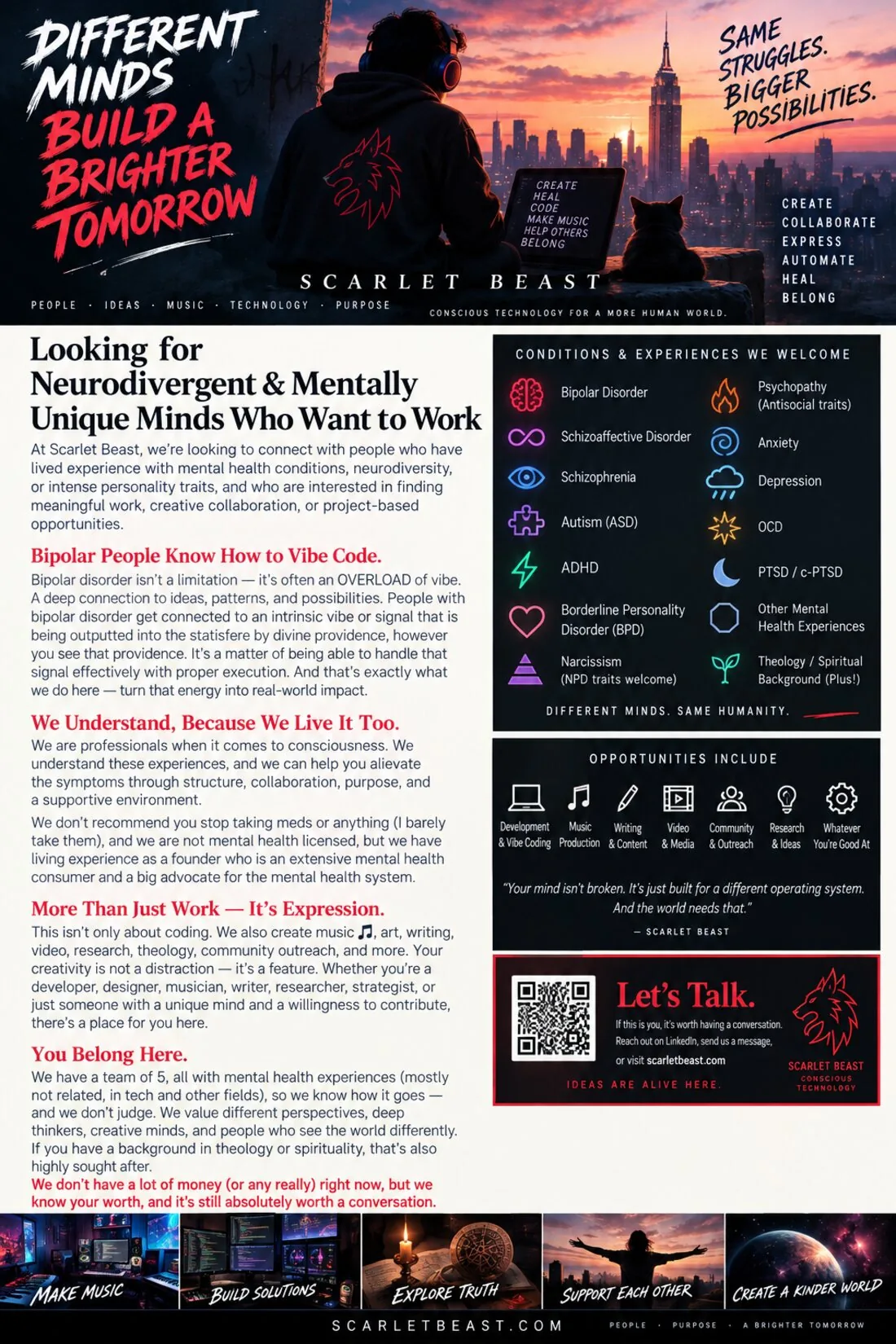
Scarlet Beast is looking for people who think differently — and who want to make music, build technology, write, research, or find people who actually understand.
Looking for neurodivergent and mentally unique minds who want to work.
If your mind works outside the expected range — and you are trying to find meaningful work, create music, build technology, or find people who understand — we want to talk.
Scarlet Beast believes minds like that bring unusual strengths: creativity, intensity, pattern recognition, imagination, deep focus, unconventional thinking, resilience, emotional depth, and the ability to make connections other people miss.
That matters in AI, coding, music production, songwriting, sound design, performance, design, theology, writing, research, automation and creative technology.
Bipolar people know how to vibe code.
Bipolar disorder isn't a limitation — it's often an overload of vibe. A deep connection to ideas, patterns and possibilities. The signal comes in faster than most people can take it.
The challenge was never the signal. It's learning to channel that intensity into something real while managing symptoms sustainably. That's the part we can help with — structure, collaboration, purpose, and people who don't flinch.
Music matters here.
If you make beats, write songs, rap, sing, produce, mix, engineer, experiment with sound, create AI music, or just have something inside you that needs to become music — we want to hear it.
Bring the thing you made at 4am that you haven't shown anybody.
We understand, because we live it too.
Our small team of five all have mental-health experience — mostly not related, in tech and other fields. Some of us have histories we've had to explain in rooms where nobody wanted to hear it. So we know how it goes, and we don't judge.
Scarlet Beast is not a mental-health provider. We do not diagnose, we do not treat, and we will never recommend that anyone stop taking their medication. Our founder is an extensive mental-health consumer and an advocate for the system — not a clinician.
What we can offer is lived experience, flexibility, collaboration, understanding, and a judgment-free environment. We know someone can be brilliant and still struggle with consistency, communication, conventional workplaces, relationships, or simply being understood.
Working somewhere else, and a few changes would help you do the job? You have the right to ask. Our free accommodation letter builder helps you write the request without naming your diagnosis. It is private and stays on your device.
Starting a new job, class or team? Our free How I work builder helps you make a one-page guide to you: how to talk with you, what helps you work, what stress looks like on you and what helps, all in your own words.
When words won’t come, in a meltdown, a shutdown or a loud room, our free Speak for me board shows a message in huge letters on your phone, and helps you make a card that tells people what helps you.
A record is not a character reference.
If you have a criminal background, if you're in recovery or still fighting it, if you're the person your family stopped calling — you're not disqualified here. You may be exactly who we're looking for.
Plenty of people get written off for the worst stretch of their life and never get read past it again. Applications get closed on a checkbox. Landlords stop answering. Old friends go quiet. We're not interested in running that play on anybody.
We're not asking what you did. Don't put your record, your charges, or your using history in an email to us — we don't collect any of that, and you don't need to hand it over to have a conversation. If something is genuinely relevant to the work, we'll raise it honestly, with you, when it comes up.
Applying somewhere else and dreading the background check? Our free fair-chance job kit helps you write a calm letter of explanation, practise a short, honest answer, and know your rights. It is private and stays on your device.
What we care about is the same thing we care about with everyone: what you can make, how you work, and whether you're willing to show up for the person next to you. Recovery has its own clock, and relapse is part of a lot of people's story — it doesn't end your place here.
Some work carries legal requirements we don't control — anything touching money, minors, or credentialed fields. Where that's the case we'll tell you straight instead of going quiet on you, and we'll look for the seat that does work.
Who we're talking to
You don't have to have a diagnosis or a clean history, and you never have to tell us either one. This list is here so you know you'd be in good company — not as a checklist to qualify.
- Bipolar disorder
- Schizoaffective disorder
- Schizophrenia
- Autism (ASD)
- ADHD
- Borderline personality disorder
- Narcissistic traits
- Antisocial traits
- Anxiety
- Depression
- OCD
- PTSD & c-PTSD
- Substance use & addiction
- In recovery, at any stage
- A criminal record or time served
- Rejected for your past
- Other mental-health experience
- Theology or spiritual background
What there is to do
- Development & vibe codingAI, automation, whatever you can build
- Music productionBeats, mixing, sound design, AI music
- Writing & contentSongs, essays, research, theology
- Video & mediaShooting, editing, motion, design
- Community outreachFinding and helping the next person
- Research & ideasConsciousness, philosophy, the unconventional
- Whatever you're good atGenuinely — tell us what that is

Your mind isn't broken. It's just built for a different operating system. And the world needs that.
The honest part.
We don't have much money yet — sometimes none. We're not going to dress that up. Right now this is closer to a collaboration than a salaried job, and we'll tell you exactly where things stand before you put work in.
We know your worth. It's still absolutely worth a conversation.
Let's talk.
If this is you, it's worth having a conversation.
Tell us what you make and how you work. Please don't send us medical details, your diagnosis, or your record — we don't collect any of that, and you don't need it to talk to us.
You are more than a diagnosis. Your mind may work differently. Your art may sound different. Your code may look different. That might be exactly the point.