
A few weeks ago someone in my feed said he was going to cold call 100 merchants and asked app developers to send him their elevator pitch. He’d pick the strongest one and pitch it. Cold email to brands had been brutal, he said, and he was curious whether getting someone on the phone changed anything.
I left a comment instead of a pitch. The comment was roughly: don’t pick a pitch. Build the product for them first, then call. A hundred merchants, a hundred finished concepts, delivered before a conversation ever begins.
Then I went and built it. It’s called Scarlet.
AI-madeMusic generated with Suno; the narration is a synthetic voice (Piper); the graphics are drawn in code. Directed by Scarlet Beast. How we label AI
The problem isn’t the pitch. It’s the sequence.
Every cold call in the world opens the same way. Do you have thirty seconds?
You are asking a stranger to spend their attention imagining something. They have to hold your product in their head, map it onto their business, and guess whether it would work. That is a lot of cognitive work to ask of someone who did not want the call. Most people decline, and they are being rational.
Now change the order. The call opens with a URL. They load it while you are still on the line. It is their logo, their colours, their actual products, sitting inside the thing you are selling. It already works.
The ask is no longer give me thirty seconds. It is “I already built it — tell me what’s wrong with it.”
That is a completely different conversation. You are not selling anymore. You are collecting feedback on something that exists. The prospect’s job changed from imagining to reacting, and reacting is almost free.
Nobody does this because it used to be impossible
The reason this inversion is rare is not that it’s a bad idea. It’s that building a bespoke demo used to take a developer a day, and no one spends a developer-day on a stranger who has not replied to an email.
So I costed it properly. Here is a real bespoke, working, branded demo, built unattended:
- Enrichment and fingerprinting: $0.15
- Build the concept — provision a sandbox, extract their brand, configure the product, record a walkthrough, render a one-page deck: $1.20
- Human visual QA, sampled: $0.85
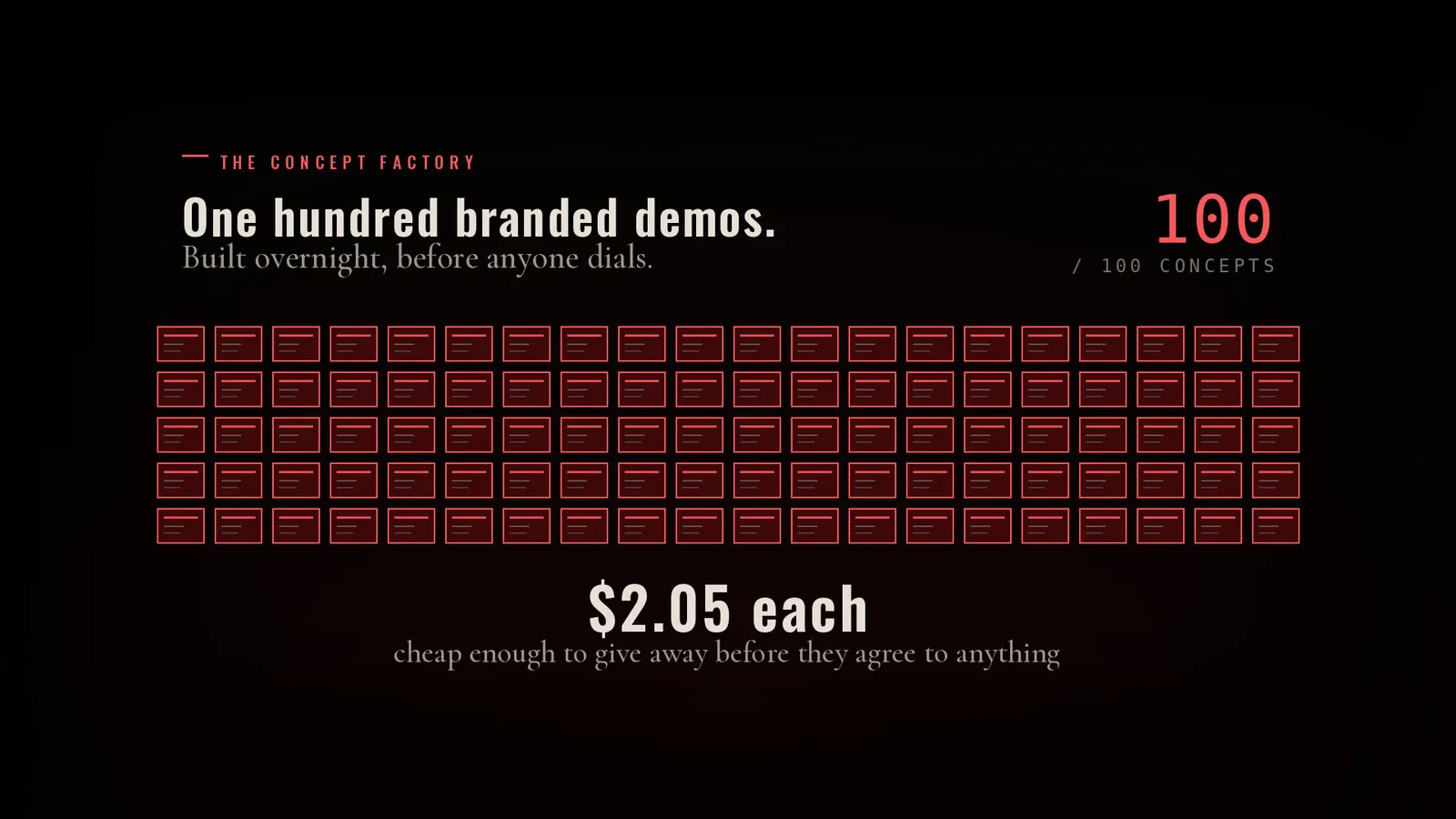
About $2.05. A hundred-prospect campaign runs roughly $210 in variable cost, and 95% of that is the concepts, not the calls. The telephony is about eight dollars.
Two dollars is the number that changes the business. At two dollars, a finished demo stops being something a prospect earns after a discovery call and becomes the thing you lead with. You can afford to give it to people who never reply.
How it actually works
Six moves. One of them is yours.
- 1. Find who is worth calling. Sweep the segment, fingerprint each company’s public stack, resolve a phone number that actually reaches an owner. Finding the business is easy. The number is the scarce input.
- 2. Build them a demo overnight. Logo, palette and real catalogue cloned into a live sandbox of the product. Configured, recorded, published at its own URL.
- 3. Send it before you dial. This one matters more than it looks. More on it below.
- 4. Call. Asterisk places it, transcription streams before their sentence ends, and the agent answers inside an 800 ms budget with real barge-in.
- 5. Warm transfer. When a prospect is ready, the call lands on a human closer with the transcript already on screen. This is the only moment in the system that needs a person — and it is deliberately yours.
- 6. Write it all to one row. Every call transcribed, scored, joined to its concept ID. That single row is how pipeline, cost per meeting and any revenue share get computed, by both sides, from the same record.
The part everyone skips: this is regulated
If you are building AI voice outbound and you have not read the February 2024 FCC declaratory ruling, stop and read it.
It holds that an AI-generated voice is an “artificial” voice under the TCPA. That does not make AI calls illegal. It puts them in the same regulated category as prerecorded calls: they need prior express consent, prior express written consent to wireless numbers, caller identification and a working opt-out. There is no general business-to-business exemption. The FTC’s Telemarketing Sales Rule exempts a lot of B2B solicitation from the national Do Not Call registry, but the TCPA’s artificial-voice rules apply to any number — and a sole proprietor’s mobile keeps full protection.
Now consider who you are calling. A large share of small-business phone numbers are the owner’s mobile. Pointing a synthetic voice at that list is the expensive kind of mistake, and exposure runs per call.
So Scarlet does not cold-dial with a synthetic voice at all. And here is the part I like: the Concept Factory turned out to be the consent mechanism as well as the pitch. The demo goes out first. The concept page carries a named, specific written opt-in. Only consented records ever reach the automated queue — enforced at the database level, not in application logic, so the dialer’s query physically cannot return an unconsented record. Everyone else routes to a human with the same demo and the same dossier.
Both paths work. Only one of them is automated end to end. The compliance constraint didn’t damage the design — it produced it.
Two things the system will not do at any price: it will not clone a real person’s voice, and it will not claim to be human, including when asked directly. That costs some connect rate. It removes an entire category of risk.
The engineering that’s actually hard
Not the AI. The clock.
The budget is the time between the prospect finishing a sentence and hearing the first syllable back: 800 ms median, 1.5 s at p90. Past that they work out they’re talking to a machine that’s thinking, and hang up.
That 800 ms is spent: 120 ms detecting end of speech, 150 ms finalising the transcript, 10 ms assembling context, 300 ms to first model token, 150 ms to first synthesized audio, 70 ms of trunk and jitter.
Look at the context line. Ten milliseconds. That is only possible because retrieval happens before the dial, not during it. Assembling a dossier mid-turn adds 200–600 ms to the first response, which is exactly where a cold call dies. The dossier is packed ahead of time and treated as read-only state during the call. That one decision is the difference between a system that works and a demo that impresses in a boardroom.
The other thing that matters is barge-in: synthesis has to stop inside 100 ms when someone talks over the agent. An agent that talks through an interruption reads as a robocall no matter how good the voice is.
What I’m not claiming
The honest part, because I’d rather you trust the numbers than the pitch.
I don’t yet know that concept-first beats a normal cold call. I believe it does. That is not the same thing.
So the pilot runs a control arm: the same list, split, dialed by the same agent with the same opener minus the URL. If meeting-set rate doesn’t separate, the Concept Factory is expensive theatre and it should be killed.
And 100 dials per arm is a smoke test, not a result. At that sample size a lift from 1% to 3% is indistinguishable from noise. Detecting a move from 3% to 7% with 80% power takes roughly 465 dials per arm. The 100-dial pilot proves the machine runs end to end and produces clean, attributable data. The powered comparison needs about a thousand dials, and that is the next spend, not the first one.
One number decides whether any of this ships: cost per qualified meeting, loaded with platform fee and usage. If it doesn’t beat what you already pay an SDR for the same outcome, the readout says so.
It’s built, and it’s public
The product site, the architecture, the call-flow diagram, the unit economics and the pricing are at scarlet.scarletbeast.com. The film above walks through the whole system.
The full statement of work — seven phases, acceptance criteria you can check in an afternoon, the consent-first compliance design, three swappable commercial models and the pilot design — is published at scarlet.scarletbeast.com/sow-01, including the parts that argue against it.
If you sell software to a definable segment and you have a sandbox or trial environment, this works for your product. Pick a segment, pick a product, and I’ll build ten concepts for ten real companies at my cost before you commit to anything. If they’re not good enough to send, there’s nothing to discuss.
Concept in. Client out.